

 English
 Japanese
 Dutch
 Chinese (Simplified)
 French
 Italian
 Korean
 Spanish
 Danish
 Norwegian
 Polish
 Russian
Bunta's Initial B
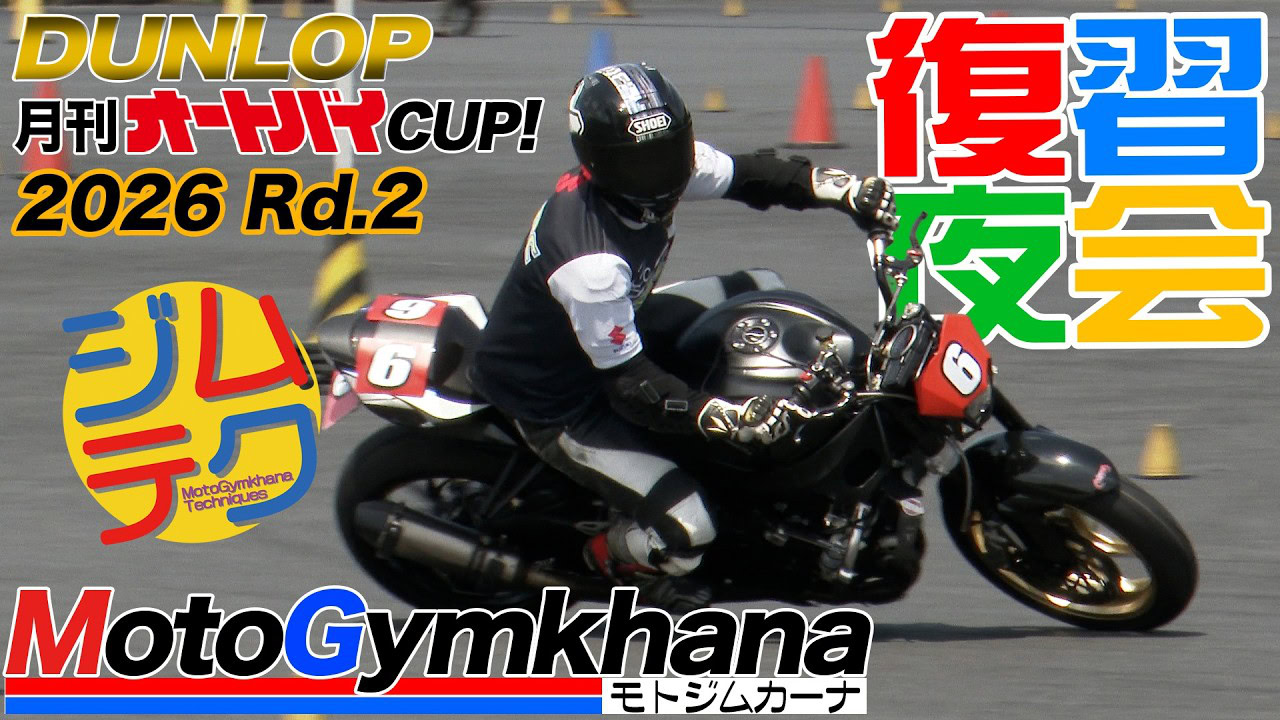
Watch Ramkhana’s video
12
May
I’d like to share my thoughts after watching the video of the recent Ramkana review session. Since I can’t make comparison videos myself, I can’t compare it to other people’s bikes, so this was very helpful.
The differences in the lines often stem from differences in the vehicle body. The difference is particularly noticeable in situations where you have to turn the handlebars sharply.
Compared to others, I hesitate to turn the handlebars sharply. Is that due to the bike’s body? Or is it due to the engine? Is this a characteristic of my riding style?
I’ve heard the saying about not letting the lamb sleep, but I want to think about why that is the case.
The basic riding technique involves making large turns and gradually turning the handlebars. Therefore, my riding style tends to involve taking a slightly wider line into corners than other riders.
Well, that line varies greatly depending on the vehicle; for example, it will be smaller if you’re riding a KX112. The ZRX1200 is on the larger side, and looking at the bikes I’ve ridden so far, I can clearly see the differences between them.
① Differences in the vehicle body
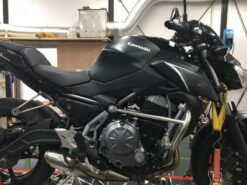
The Z650 is estimated to be 50-60 kg heavier than the CRF450, and 20-30 kg heavier than the GSXR750.
Furthermore, regarding frame strength, not only the racer CRF450, but also the TZR and GSXR all have very strong frames, and all three models use inverted forks.
The difference lies in the load capacity of the tyres. In particular, when turning sharply and making a sudden turn, it feels like the tyres can’t keep up and the bike is slightly drifting outwards. You could also say that it hasn’t bent under its own weight.
However, the moderately heavy frame provides load stability, and the moderately flexible frame makes it easy to handle, giving the rider some leeway during the two attacks. I think it gives you something special.
Even against opponents you couldn’t possibly beat in a race, you can put up a good fight in a competition. Perhaps that’s the appeal of the Z650?
② Engine differences
The 4-stroke, 4-cylinder GSXR750 and the 2-stroke, 2-cylinder TZR have the same number of explosions in a given time, so they can generate power smoothly.
For the 4-stroke single-cylinder CRF, using the clutch halfway allows you to smoothly extract power.
In comparison, the Z650, with its 4-stroke, 2-cylinder engine and longer firing intervals, has difficulty extracting power at low RPMs.
The difference in how the power is extracted can cause instability in situations where you suddenly turn the handlebars. I considered using the clutch partially, but it’s unstable and difficult to use during a race, so I don’t use it now.
Once you get up to speed, the torque and the engine’s grippy characteristics allow you to achieve comparable lap times.
Based on points ① and ②, I’ve concluded that they’re reducing lap times by running smoothly while minimising stress on the tyres.
So, how do we turn this into a close match? I think it comes down to overcoming our weaknesses and developing our strengths.
In suspension setup, even in situations where you’d normally rely on the front, you need to let the rear do more work.
Since the vehicle is inherently front-heavy, they are currently considering ways to increase the workload on the rear.
Should we strengthen the front? Or lower the rear? Well, there are various methods, but I want to consider the approach that minimises the negatives and maximises the positives.
Regarding the engine, low-speed stability and increased torque at mid-to-high RPMs will likely be essential.
Regarding the engine, we’re already in the process of re-setting up the sub-controller. The BRL sub-controller, which previously only controlled throttle opening, can now also control the vacuum system.
Since it’s now easier to control the engine from idling to small throttle openings, I think I’ll be able to drive more smoothly with a different control setup than before.
Up until now, I’ve been trying to make it easier to ride by reducing the low-speed torque, so I’ve been setting it up with a leaner mixture at low speeds.
Going forward, I think I can make the negative pressure control “around idle” richer, and then adjust in the section where I open the throttle further to prioritise acceleration, and instead of controlling the engine to find the ideal air-fuel ratio, we’re aiming for control that maximises lap times.
This is quite challenging, but we intend to take our time and continuously improve the engine.
While it’s impossible to hide the decline in a rider’s performance due to ageing, I hope to somehow keep up with the top riders through experience and machine control.
https://ssbfactory.seesaa.net/article/520661554.html
Shop the part in this post:

¥71,874


¥22,627

